
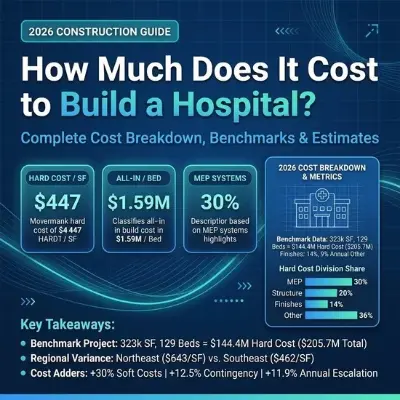
Hospitals cost more per square foot than most commercial buildings. Continuous operation, redundant systems, and strict health-care codes drive that premium.
GCs, subs, and bidders need one benchmark, one location table, and one escalation check before they price a hospital. Hard cost means direct labor, materials, equipment, and contractor markup. Every figure below is hard cost unless the text says otherwise.
Key figures
- Hospital hard cost: $447 per square foot (SF) of gross floor area.
- Benchmark hospital: 323,000 SF, 129 beds, and $144.4 million in hard cost.
- Cost per bed: $1.12 million in hard cost and $1.59 million with soft costs and contingency.
- Soft costs add 30% of hard cost. Contingency adds 12.5%.
- Mechanical, electrical, and plumbing (MEP) systems take 30% of hard cost.
- Northeast hospitals cost 39% more per SF than Southeast hospitals.
- Construction input prices rose 11.9% from September 2025 to September 2026.
- Steel mill product prices rose 19.6% from February 2026 to September 2026.
What Does It Cost to Build a Hospital in 2026?
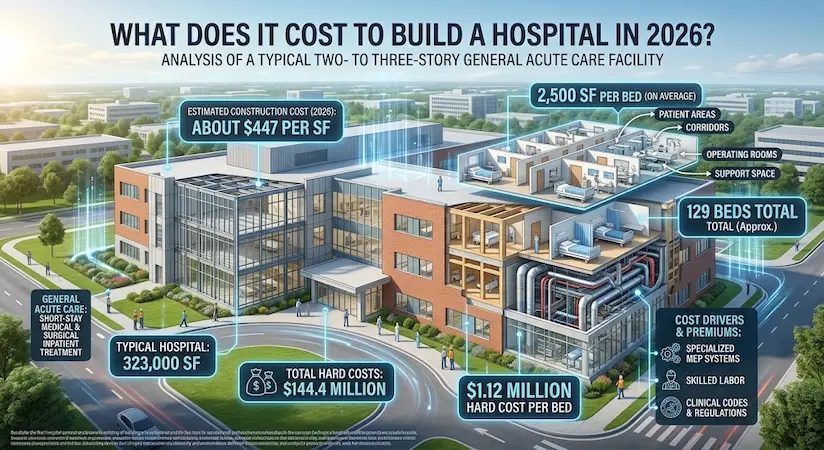
A hospital costs about $447 per SF to build in 2026. A typical 323,000 SF hospital costs $144.4 million in hard costs.
The benchmark reflects a two- to three-story general acute care hospital. General acute care means short-stay medical and surgical inpatient treatment. Structure and exterior materials move the price. Examples include a steel-framed curtain wall and brick veneer over wood frame.
A hospital averages 2,500 SF per bed once corridors, operating rooms, and support space count. That puts the benchmark hospital at 129 beds and $1.12 million of hard cost per bed. Specialized MEP systems, skilled labor, and clinical codes drive most of the premium.
How Does Hospital Size Change the Total Cost?
Total cost scales with bed count at $1.12 million per bed. A 100-bed hospital needs 250,000 SF and costs $111.8 million.
Each bed needs 2,500 SF of gross area. The table assumes a three-story building with a square floor plate. Costs use $447 per SF.
| Beds | Gross area (SF) | Footprint, three stories (ft × ft) | Hard cost |
| 50 | 125,000 | 204 × 204 | $55.9 million |
| 80 | 200,000 | 258 × 258 | $89.4 million |
| 100 | 250,000 | 289 × 289 | $111.8 million |
| 129 (benchmark) | 323,000 | 328 × 328 | $144.4 million |
| 150 | 375,000 | 354 × 354 | $167.6 million |
| 178 | 445,000 | 385 × 385 | $198.9 million |
Specialty and teaching hospitals need more area per bed. They also carry a higher cost per SF.
How Do Costs Differ by Hospital Type?
Specialty and tertiary hospitals cost more per SF than general hospitals. A large tertiary hospital costs $676 per SF, which is 51% above the benchmark.
Outpatient surgery centers carry heavy HVAC and medical gas loads. Medical gas piping delivers oxygen, vacuum, and medical air to clinical rooms. Smaller buildings cost less per SF.
| Facility type | Typical size (SF) | Cost per SF | Hard cost |
| General acute care | 323,000 | $447 | $144.4 million |
| Large tertiary hospital | 600,000 | $676 | $405.6 million |
| Specialty (cancer, cardiac) | 112,500 | $596 | $67.1 million |
| Outpatient surgery center | 50,000 | $546 | $27.3 million |
| Ambulatory care center | 70,000 | $422 | $29.5 million |
| Micro-hospital or urgent care | 20,000 | $360 | $7.2 million |
Specialty hospitals use about 3,000 SF per bed. At $596 per SF, that equals $1.79 million per bed.
What Is the Total Project Cost After Soft Costs and Contingency?
Soft costs add 30% of hard cost, and contingency adds 12.5%. The benchmark hospital reaches $205.7 million, or $1.59 million per bed.
Soft costs cover design fees, permits, legal fees, financing, and equipment procurement. Contingency is a reserve for unforeseen conditions. Land stays outside every figure. Hard cost stops at the contractor’s scope.
| Cost layer | Basis | Benchmark hospital |
| Hard cost | 323,000 SF × $447 per SF | $144.4 million |
| Soft costs | 30% of hard cost | $43.3 million |
| Contingency | 12.5% of hard cost | $18.0 million |
| Total project cost | Sum of layers | $205.7 million |
| Cost per bed | $205.7 million ÷ 129 beds | $1.59 million |
Moveable furniture and medical equipment usually sit outside at a hard cost. Budget them as separate owner items.
Where Does the Money Go in a Hospital Budget?
MEP systems take 30% of hospital hard costs, or $43.31 million on the benchmark hospital. Structure takes 20%, and finishes take 14%.
MasterFormat is the Construction Specifications Institute numbering system for work divisions. Divisions 21, 22, 23, and 26 hold fire suppression, plumbing, HVAC, and electrical work. Medical gas piping falls under section 22 63 00.
Ducts, conduit, and pipe compete for tight ceiling space. Clashes between them cause change orders. Bidders should use specialized MEP estimating to price these systems early. MEP work is labor-intensive, so crew availability moves the price. Plumbing materials rose 8.5% in the second half of 2025.
| Component | MasterFormat divisions | Share | Cost per SF | Benchmark cost |
| MEP systems | 21, 22, 23, 26 | 30% | $134.1 | $43.31 million |
| Structure and framing | 03, 05 | 20% | $89.4 | $28.88 million |
| Finishes and interiors | 09 | 14% | $62.6 | $20.21 million |
| Medical equipment infrastructure | 11 | 10% | $44.7 | $14.44 million |
| Technology and IT | 27, 28 | 7.5% | $33.5 | $10.83 million |
| Site work and utilities | 31, 32, 33 | 6.5% | $29.1 | $9.38 million |
| General conditions, overhead, and profit | 01 | 12% | $53.6 | $17.33 million |
| Total | All | 100% | $447.0 | $144.38 million |
How Much Does Location Change Hospital Construction Costs?
Northeast hospitals cost $643 per SF, which is 39% more than Southeast hospitals at $462 per SF.
A location factor equals regional cost per SF divided by the national benchmark. Union wages, permitting rules, seismic codes, and market demand create the spread. West Coast seismic and sustainability rules push costs up.
Urban projects also cost more than rural projects. A HRSA-supported review of 450 health-center budgets found higher urban costs in every cost category. Alaska and Hawaii cost the most because shipping inflates material prices.
| Region | Location factor | Cost per SF | Benchmark hospital cost | Main driver |
| Northeast | 1.44 | $643 | $207.7 million | Union wages, permitting |
| West Coast | 1.37 | $614 | $198.3 million | Seismic and sustainability codes |
| Mountain West | 1.16 | $519 | $167.6 million | Logistics and seasonal weather |
| Midwest | 1.12 | $499 | $161.2 million | Moderate labor cost |
| Southwest | 1.07 | $477 | $154.1 million | Growing healthcare demand |
| Southeast | 1.03 | $462 | $149.2 million | Competitive labor market |
| National benchmark | 1.00 | $447 | $144.4 million | Base case |
How Do You Convert Beds Into Square Feet and Cost?
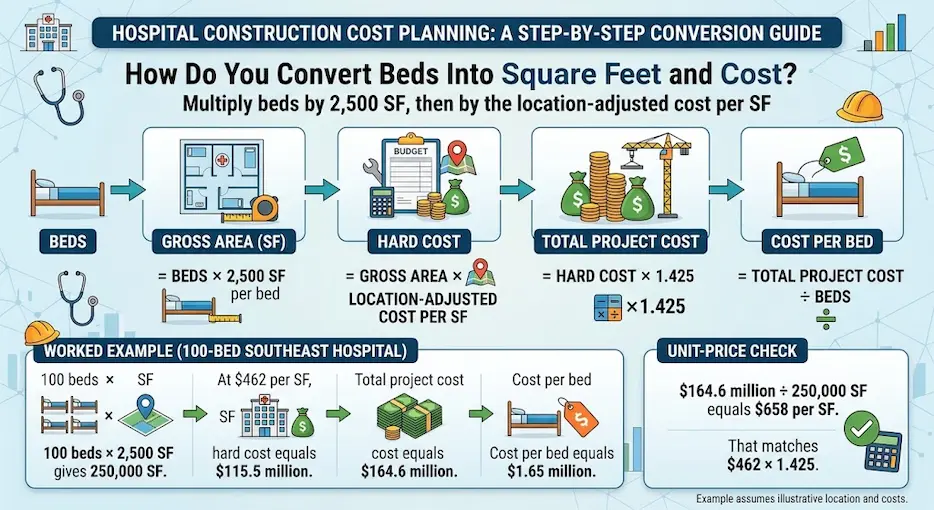
Multiply beds by 2,500 SF, then by the location-adjusted cost per SF. A 100-bed Southeast hospital costs $115.5 million in hard costs.
Bed-to-area conversion is the first quantity step on hospital work. Use four formulas:
- Gross area (SF) = beds × 2,500 SF per bed.
- Hard cost = gross area × location-adjusted cost per SF.
- Total project cost = hard cost × 1.425.
- Cost per bed = total project cost ÷ beds.
Worked example: 100 beds × 2,500 SF gives 250,000 SF. At $462 per SF, hard cost equals $115.5 million. Total project cost equals $164.6 million. Cost per bed equals $1.65 million.
The unit-price check confirms the result. $164.6 million ÷ 250,000 SF equals $658 per SF. That matches $462 × 1.425.
Need a Defensible Hospital Estimate?Design And Bids brings 20+ years of experience to construction cost estimating services. The team covers projects nationwide. Request a hospital estimate from Design And Bids and price your next bid with confidence! |
What Structural and Systems Choices Drive Hospital Cost and Failure Risk?
Heavy floor loads, dense MEP routing, and redundant utilities drive hospital costs. Missed trade clashes create costly change orders.
Imaging equipment adds concentrated loads and vibration limits. Slab thickness and reinforcement change the concrete price, so review this concrete slab cost guide before you price floors.
Tight ceiling space forces rework when ducts, conduit, and pipe collide. Redundant power and emergency generation keep critical systems running during outages.
CMS requires hospitals to follow the 2012 edition of NFPA 101, the Life Safety Code. It also requires the 2012 edition of NFPA 99, the Health Care Facilities Code, with limited exceptions. HHS publishes the rule summary.
NFPA 99 also sets risk categories for medical gas systems. Copper tube for those systems follows ASTM B819, so copper prices flow into plumbing bids. The Facility Guidelines Institute (FGI) publishes hospital design guidelines. States adopt different editions, so confirm the adopted edition before design closes.
Should You Build New, Renovate, or Replace a Hospital?
Renovation usually costs less than new construction before infection-control and service-interruption costs. Replacement costs the new-build price plus removal of the old facility.
Renovation keeps patients in the building, which adds phasing and infection-control work. Price demolition, abatement, and patient relocation as separate line items. Converting a non-clinical building can cost more than new construction. Older facilities with environmental issues behave the same way.
Five signs point to replacement:
- Floor-to-floor height cannot fit modern duct and pipe runs.
- The structure cannot carry imaging equipment loads.
- Mechanical and electrical systems have reached the end of service life.
- Existing rooms cannot meet the state-adopted FGI edition.
- Renovation phasing would close too many beds.
What Is Driving Hospital Construction Prices Right Now?
Construction input prices rose 11.9% from September 2025 to September 2026. Steel mill products rose 19.6% from February 2026 to September 2026.
The Producer Price Index (PPI) from the Bureau of Labor Statistics (BLS) tracks price change from the seller’s view. Higher steel prices raise structural steel and metal deck bids. Higher copper prices raise plumbing and electrical bids. Steel gained the most, so structural packages carry the most escalation risk.
| Index | BLS series | Latest value | Change |
| Net inputs to new nonresidential construction | WPUIP231200 | 173.212 (Sep 2026) | +11.9% since Sep 2025 |
| Steel mill products | WPU1017 | 388.580 (Sep 2026) | +19.6% since Feb 2026 |
| Copper and brass mill shapes | WPU102502 | 835.342 (Sep 2026) | +3.2% since May 2026 |
How Do Hospital Construction Phases and Timelines Work?
A general acute care hospital takes about 30 months to build. Work moves through eight phases, from approvals to patient occupancy.
- Secure local building permits and state health-department plan review.
- Finish design and preconstruction estimating against the adopted FGI edition.
- Build site work and utilities (Divisions 31, 32, and 33).
- Place foundations and structure (Divisions 03 and 05).
- Close the building envelope (Divisions 07 and 08).
- Rough in MEP, medical gas, and low-voltage systems (Divisions 21 to 28).
- Install finishes and medical equipment infrastructure (Divisions 09 and 11).
- Test, commission, and certify medical gas and life-safety systems.
Licensing inspection and system certification set the occupancy date. Concrete curing does not. Confirm the exact permit path with your state agency.
What Do Maintenance and Lifecycle Costs Add Up To?
Over an assumed 50-year service life, hospital hard cost equals $8.94 per SF per year. That is $2.89 million per year for the benchmark hospital.
The shell, fit-out, and medical equipment wear out on different cycles. Energy dominates operating costs because hospitals run around the clock. Plan MEP replacement as a recurring capital item. Operating costs add to the annual figure above.
How Does Hospital Cost Compare With Other Commercial Buildings?
A hospital costs 15% more per SF than an office building and 94% more than a K-12 school. Hospitals cost $447 per SF, against $388 for offices.
Continuous operation, heavy ventilation, and redundant power create the gap. Apartments can exceed hospitals when finishes and parking raise the price. Owners who compare building types should review commercial estimating services for scope detail.
| Building type | Cost per SF | Hospital premium |
| Hospital | $447 | Base |
| Apartment complex | $460 | 3% lower |
| Ambulatory care center | $422 | 6% higher |
| Office building | $388 | 15% higher |
| K-12 school | $230 | 94% higher |
How Can You Reduce Hospital Construction Costs?
Avoiding a compressed schedule saves 11.5%, or $16.6 million on the benchmark hospital. Early GC coordination also catches costly details before drawings close.
| Method | Effect |
| Avoid compressed delivery | Removes an 11.5% premium, or $16.6 million |
| Lock plumbing prices early | Avoids a repeat of the 8.5% rise seen in late 2025 |
| Use efficient floor plates | Shortens corridors and MEP runs |
| Prefabricate bathroom pods and headwalls | Cuts on-site labor hours |
| Phase construction | Opens beds sooner and spreads cost |
| Coordinate MEP early | Cuts clash-driven change orders |
Which Cost Adders Should Bidders Price?
Soft costs add 30% of hard cost, and contingency adds 12.5%. A compressed schedule adds another 11.5%.
| Adder | Rate | Benchmark dollars | When it applies |
| Soft costs | 30% of hard cost | $43.3 million | Every project |
| Contingency | 12.5% of hard cost | $18.0 million | Every project |
| Compressed schedule | 11.5% of hard cost | $16.6 million | Fast-track delivery |
Price these items as separate lump sums:
- Infection-control barriers and negative-pressure enclosures.
- Off-hours work in occupied buildings.
- Temporary power and utilities.
- Commissioning and certification support.
- Steel and copper escalation, using the BLS series above.
What Weather and Site Limits Affect Hospital Construction?
Cold-weather rules apply when air temperature falls to 40°F during the protection period. Below 40°F, the hydration reaction in concrete slows.
Hydration is the chemical reaction that hardens cement. The protection period is the time concrete needs shelter from cold. The NIH technical bulletin on cold-weather concreting cites ACI 306R-16. It also advises crews to record concrete surface temperature.
Urban sites add staging limits. Rural sites add utility extensions. Rock under the footprint can force blasting or costly foundation design, so review geotechnical data before bid day.
How Do You Level Hospital Bids?
Level hospital bids by MasterFormat division, then test each division against the benchmark split. A MEP bid far below 30% of hard cost signals missing scope.
Bid leveling adjusts every bid to the same scope, so packages compare fairly. Missed scope ranks among the common construction mistakes that erode margin. Check each bid for:
- Medical gas, vacuum, and nurse call scope in Divisions 22 and 27.
- Temporary power, infection-control barriers, and commissioning support.
- Radiation shielding and equipment infrastructure in Division 11.
- Owner-furnished equipment and who installs it.
- Allowances, alternates, and unit prices.
- Escalation basis: named index, base month, and cap.
- Schedule basis, including any compressed-delivery premium.
- Exclusions for occupied-building phasing and off-hours work.
How Do GCs and Subs Estimate a Hospital Step by Step?
Take off quantities by division, price them, apply the location factor, add escalation, then check the total against per-SF and per-bed benchmarks.
- Take off quantities from drawings by the MasterFormat division.
- Price each division with current subcontractor and supplier quotes.
- Apply the location factor to every benchmark you use for checks.
- Add escalation from a named BLS index and a base month.
- Add general conditions, overhead, profit, and contingency.
- Check the total against per-SF and per-bed benchmarks.
A worked example for a 100-bed Southeast hospital: the hard cost check equals 250,000 SF × $462, or $115.5 million. The MEP check equals 30% × $115.5 million, or $34.65 million. A $30 million MEP bid sits 13% below that check. That gap needs a scope review.
Who Should Build a Hospital, and What Should You Ask Contractors?
Hire a healthcare-experienced contractor with qualified medical gas installers. Hospitals leave no room for DIY or unlicensed work.
Ask every bidder these questions:
- Which hospital projects did you finish under the state-adopted FGI edition?
- Do your medical gas installers and verifiers hold current qualifications?
- How do you run infection-control risk assessments during construction?
- Which index and base month support your escalation clause?
- Who carries the commissioning and certification scope?
Confirm the warranty start date, covered systems, and response time for MEP equipment. Treat these as scam red flags:
- An MEP price far below the benchmark share.
- No named escalation index.
- Vague exclusions.
- Pressure to sign before addenda arrive.
Avoid Costly Hospital Construction Errors!
Get a detailed hospital construction cost estimate from our professional team to plan your budget accurately.
What Do Bidders Ask About Hospital Construction Costs?
How should bidders carry escalation over a 30-month hospital build?
Split material purchases by delivery month, then escalate each tranche from a named BLS index. The BLS price adjustment guide advises citing the full index title. Use this formula: (current index − base index) ÷ base index × material value. Example: $5 million of steel at the February 2026 base of 324.930 costs $0.98 million more at the September 2026 value of 388.580. Escalate plumbing and electrical packages from copper series.
How much does a 50-bed hospital cost?
A 50-bed hospital needs 125,000 SF and costs $55.9 million in hard costs. At 2,500 SF per bed and $447 per SF, hard cost stays at $1.12 million per bed. Soft costs and contingency bring the all-in cost to $1.59 million per bed.
What does the cost to build a hospital leave out?
Hospital hard cost excludes land, soft costs, contingency, and owner-bought equipment. Land prices vary too widely for any national figure. Financing, legal fees, and design fees sit in soft costs. Moveable furniture and medical equipment count as furniture, fixtures, and equipment (FF&E). Confirm each bid’s exclusions line by line.
How do infection control and phasing change renovation pricing?
Renovation pricing must add infection-control barriers, phasing, and off-hours work as separate line items. Renovation often costs less than new construction before those items. Dust and debris can spread infection in an occupied building. Hospitals typically run an infection control risk assessment (ICRA) before work starts. Price barriers, enclosures, and patient-relocation support for each phase.
Does a hospital cost more per square foot than an ambulatory care center?
Yes. A hospital costs $447 per SF, which is $25 more than the $422 per SF for an ambulatory care center. That gap equals 5.9%. Inpatient floors add medical gas, nurse call, and round-the-clock mechanical loads. A micro-hospital at $360 per SF costs 24% less than the benchmark hospital.
How much contingency should a hospital bid carry?
Carry 12.5% of hard cost, or $18.0 million on the benchmark hospital. Complex clinical scope and hidden site conditions drive that reserve. Early design stages need the full amount. Release contingency as design gaps close.
Conclusion
Budget $447 per SF in hard cost, adjust by region, and add 30% soft costs plus 12.5% contingency. That puts the benchmark hospital at $205.7 million.
Escalation risk now exceeds many published forecasts because construction input prices rose 11.9% in one year. MEP systems hold 30% of hard cost, so price and level them first. Check every estimate against per-SF and per-bed numbers.
