
Drywall Installation Cost 2026: Pricing Guide Per Square Foot
Drywall installation costs range from $1.50 to $4.00 per square foot installed, including materials, hanging, taping, and finishing. Basic Level 0–2 work in rural or lower-cost states like Texas and the Southeast can cost as little as $1.50 per square foot, while Level 5 finishes in high-cost metros like California, New York, or Austin can reach $4.00+ per square foot.
Drywall is often one of the most miscalculated costs in renovation and new-build projects. If you miscalculate square footage, ignore that ceilings cost more than walls, or skip the finish level discussion, a $1,500 budget can quickly turn into a $4,000 bill. Underbidding based on floor area instead of actual wall-and-ceiling surface area can eat into your margin.
This guide breaks down drywall installation costs by walls, ceilings, bathrooms, garages, basements, whole houses, finish levels, materials, labor rates, and regional pricing.
What is the Drywall Cost Per Square Foot?
The drywall cost is $1.50 to $4.00 per square foot. When most people hear $1.50 to $4.00 per square foot, they picture one flat charge. In reality, that number is made up of two very different costs, and understanding the split changes how you budget or bid. The total cost is basically due to two main components:
- Material Cost
- Labor Cost
Material Cost
This covers the drywall sheets themselves, joint compound, tape, screws, and corner bead. Material costs are fairly predictable. They don’t swing much based on who’s doing the work, only on what type and thickness of board you choose.
Labor Cost
This involves hanging, taping, mudding, sanding, and finishing, and it’s where the real money is spent. Labor typically accounts for 65% to 75% of the total installation cost, sometimes even more on complex or high-end jobs.
| Cost Component | Range per sq ft | Share of Total Cost |
| Materials | $0.50 – $0.80 | ~25–35% |
| Labor | $1.00 – $3.20 | ~65–75% |
| Total Installed | $1.50 – $4.00 | 100% |
How to Calculate the Cost of Drywall Material?
Calculating the cost of drywall material starts with knowing your square footage, then multiplying it by the price per square foot for the type of drywall you need.
Not all drywall costs the same. The type you choose affects the final budget. Choosing drywall material depends on the room, moisture exposure, and fire code requirements. Below is a breakdown of every major drywall type used in U.S. homes and their costs in 2026.
Standard Drywall (1/2″ and 5/8″)
It is used in bedrooms, living rooms, hallways, and most interior walls and ceilings that don’t face moisture or fire-code requirements. It’s the most affordable, easiest to cut and finish, and works for the vast majority of a home’s square footage. The average price of this drywall for 2026 is $0.30–$0.42 per sq ft (1/2″) and $0.35–$0.48 per sq ft (5/8″).
Moisture-Resistant Drywall (Green Board)
It is used in bathrooms, laundry rooms, and kitchen walls near sinks or in areas where humidity is common, but not in areas of direct water contact. Its treated paper facing resists moisture absorption better than standard board, reducing the risk of mold in damp areas. In 2026, the average price for this wall material is $0.42 – $0.55 per sq ft.
Mold-Resistant Drywall (Purple Board / Paperless)
It is used in high-humidity basements, coastal homes, and bathrooms in the Gulf Coast or humid Southern states. Its fiberglass-faced core resists both moisture and mold growth better than standard green board, ideal for extra-wet climates. The 2026 average price varies from $0.55 to $0.80 per sq ft.
Fire-Resistant Drywall (Type X, 5/8″)
It is used in attached garages, furnace/utility rooms, and shared walls between units in multi-family buildings. It is commonly used in buildings where fire codes require it due to high fire risk. Its denser gypsum core slows fire spread for roughly one hour. In 2026, the average price is $0.45 – $0.85 per sq ft.
Soundproof Drywall
It is used in home theaters, music rooms, primary bedrooms, and shared walls in apartments or duplexes. It is built with sound-dampening layers or higher-density materials, which significantly reduce noise transfer between rooms. $1.00–$3.00 per sq ft is the price for 2026.
Eco-Friendly Drywall
It is used in any room and is typically chosen by homeowners who prioritize recycled content or low-VOC materials. As it is made with recycled gypsum or paper, it performs like standard board while reducing environmental impact. Its average price for 2026 is $0.70 – $0.90 per sq ft.
How to Calculate Drywall Labor Cost?
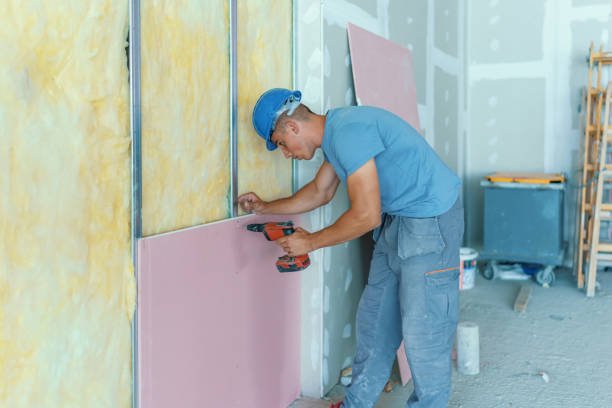
Calculating labor cost isn’t as simple as multiplying square footage by an hourly rate. It depends on the scope of work, finish level, crew size, and regional wage rates. Here’s how labor cost is actually built, step by step.
Hourly Rate vs. Per-Square-Foot Pricing
Most drywall professionals charge $40 to $100 per hour, but for anything beyond a small patch job, pricing shifts to a per-square-foot basis since it’s easier to estimate accurately and compare across contractors. As a standalone number, labor typically runs $1.00 to $3.20 per square foot, separate from material cost.
Labor Cost by Scope of Work
Drywall labor isn’t one task. It’s several steps of work, and many contractors price each stage separately:
- Hanging only: $0.55 – $1.20 per sq ft
- Taping and mudding: $0.35 – $1.10 per sq ft
- Texturing (if added): $0.80 – $2.00 per sq ft
Breaking labor down this way is useful because it shows exactly where you can save. Skipping texture or choosing a lower finish level directly reduces labor costs without affecting material quality.
Labor Cost by Finish Level
Just like material cost scales with drywall type, labor cost scales with finish level. Each additional coat of joint compound and round of sanding adds hours to the job:
| Finish Level | Labor Cost per sq ft |
| Level 0 (hung only) | $0.85 – $1.90 |
| Level 2 (one coat) | $1.30 – $2.60 |
| Level 4 (standard residential) | $1.70 – $3.20 |
| Level 5 (skim coat, gloss-ready) | $1.75 – $4.00 |
Crew Production Rates
This is the part homeowners rarely see, but contractors rely on daily. A standard 4-person crew can hang 45 to 80 sheets per day, covering roughly 1,500 to 2,500 square feet. A skilled finisher working alone typically completes 200 to 400 square feet per day, depending on the required finish level. These production rates are what separate an accurate bid from a guess.
Once you know your square footage and production rate, labor cost follows a simple formula:
Total Sq Ft ÷ Daily Production Rate = Labor Days
Labor Days × Crew Size × Hourly Rate = Total Labor Cost
Worked example: A 600 sq ft job, hung by a 2-person crew at 40 sheets/day (1,280 sq ft/day combined), finished by one person at 300 sq ft/day:
Hanging: 600 ÷ 1,280 ≈ 0.5 day → roughly half a day for 2 workers
Finishing: 600 ÷ 300 = 2 days for one finisher
At a blended labor rate of $60/hour (8-hour day), total labor cost lands around $1,300 to $1,440, before overhead and profit.
Factors That Increase Labor Cost Above Average Rate
- Ceiling height: anything above 8 feet requires stilts, benches, or scaffolding
- Vaulted, tray, or coffered ceilings: add 15–25% more labor time for panel handling
- Tight spaces: bathrooms, closets, and stairwells slow crews down disproportionately
- Poor site access: second-floor work without a lift or elevator adds material-handling hours
- Complex layouts: more corners, openings, and cutouts mean more detail work per square foot
Let’s Get In Touch
Get An Accurate Drywall Installation Cost Estimate With A Call!
Does Drywall Installation Cost Vary by State?
Yes, drywall pricing swings dramatically by region. Coastal metros like California and the Northeast have the highest costs due to labor and code requirements, while rural Southern and Midwest markets remain the most affordable nationwide.
Drywall Installation Cost by Region: 2026 (Fully Installed, Level 4 Finish)
| Region | States (Examples) | Cost per Sq Ft (Installed) | Why This Range |
| West Coast | CA, WA, OR | $2.50 – $4.00 | Highest cost of living, strong union presence, high material transport costs, strict seismic/fire code requirements |
| Northeast | NY, MA, NJ, CT, PA | $2.30 – $3.75 | High labor wages, older housing stock requiring more prep/remediation, dense urban logistics |
| Mountain West | CO, UT, ID, MT, AZ | $1.90 – $2.90 | Rapid population growth is driving up demand and wages faster than the supply of skilled crews |
| Midwest | OH, IN, IL, MI, WI, MO | $1.25 – $2.00 | Moderate labor costs, stable material supply chains, and lower cost of living |
| South (High-Volume) | TX, FL, GA, NC | $1.50 – $2.85 | High construction volume keeps competition strong; open-shop labor in states like TX keeps wages lower |
| South (Rural/Lower-Cost) | MS, AL, AR, rural TX/GA | $1.50 – $2.00 | Lowest labor costs in the country and limited contractor competition keep pricing low, but options are fewer. |
How to Calculate an Accurate Estimate for Drywall?
Step 1: Measure Wall and Ceiling Area (Not Floor Area)
Measure the length and height of every wall you’re drywalling, and multiply to get the square footage per wall. Add ceiling square footage (length × width) if it’s part of the scope. This is the “surface area, not floor area.” It’s the foundation of an accurate material count.
Wall Area = Length × Height (per wall, then add all walls together)
Ceiling Area = Room Length × Room Width
Total Drywall Area = Wall Area + Ceiling Area
Step 2: Subtract Openings
Doors, windows, and large vents don’t need drywall. Subtract their area to avoid over-ordering
Net Drywall Area = Total Drywall Area – (Doors + Windows + Other Openings)
Step 3: Divide by Sheet Size to Get Sheet Count
Standard drywall sheets come in a few common sizes, which are
- 4×8 sheet
- 4×10 sheet
- 4×12 sheet
. Divide your net area by the sheet size to get a baseline sheet count:
Baseline Sheets Needed = Net Drywall Area ÷ Sheet Size (sq ft)
Step 4: Add a Waste Factor
This is the step most people skip and the one that causes mid-job shortages. No matter how careful the layout, cuts, breakage, and trim waste eat into your material. Industry standard waste factors are:
- 10% waste for standard rectangular rooms with simple layouts (bedrooms, living rooms, garages)
- 15% waste for complex layouts with lots of corners, angles, vaulted ceilings, arches, or many openings (bathrooms, kitchens, custom-designed spaces)
Final Sheets Needed = Baseline Sheets × (1 + Waste Factor)
Worked Example to Make It Clear
Let’s calculate a 12×14 room with 9-foot ceilings, one door, and two windows—a fairly standard layout.
- Wall area: (12+14+12+14) × 9 = 468 sq ft
- Ceiling area: 12 × 14 = 168 sq ft
- Total area: 468 + 168 = 636 sq ft
- Subtract openings: 636 – 21 (door) – 30 (2 windows) = 585 sq ft net
- Sheets needed (4×8 = 32 sq ft): 585 ÷ 32 = 18.3 → round up to 19 sheets
- Apply 10% waste factor: 19 × 1.10 = 20.9 → round up to 21 sheets
That’s your final order quantity, enough to complete the job without a mid-project store run, and without paying for board you’ll never use.
Step 5: Check Material and Labor Cost
The next step is to calculate the material and installation costs. For this, check the latest prices of your required sheets in your area and the labor cost. Do not forget to check the regulatory compliance fee.
Why Are Drywall Prices High in 2026?
Several factors are driving drywall costs up this year, and it’s not just contractor markups.
Material Cost Escalation
Gypsum, a core raw material for drywall, has seen sustained price pressure, with the U.S. producer price index for gypsum products reaching 403.12 as of April 2026, up from previous years. Manufacturers have also been shifting toward mined gypsum, which costs more to source and process than the synthetic gypsum previously used.
Tariffs Implementation
New import tariffs on gypsum, lumber, and related building materials from Canada, Mexico, and China — tracked in the U.S. Bureau of Labor Statistics‘ Producer Price Index for construction inputs — have raised costs for producers relying on imported materials, tightened domestic supply, and pushed prices higher across the market.
Labor Shortages
They are compounding the problem. Drywall is one of the most labor-intensive trades, and immigrant workers make up over 60% of the workforce in trades like drywall, roofing, and plastering, a segment currently experiencing wage pressure and workforce disruptions.
Let’s Get In Touch
Get An Accurate Drywall Installation Cost Estimate With A Call!
How to Optimize Drywall Installation Cost?
- Match the finish level to the room. Skip Level 5 in garages or closets; Levels 3 or 4 look fine and cut labor costs significantly without sacrificing quality.
- Use larger sheets (4×12) on long walls. Fewer seams mean less taping, mudding, and sanding time, directly reducing labor hours billed per square foot.
- Bundle all rooms into one project. Splitting work into phases means paying for site setup and mobilization multiple times instead of just once.
- Compare three quotes with identical specs. Confirm every bid states the same finish level and waste factor, or you’re comparing incomparable numbers, not real prices.
- Scheduling work during the off-peak season, such as late fall and winter, often yields better rates and faster contractor availability than during the busy spring and summer months.
- Use texture to mask lower finish levels. Knockdown or orange-peel texture can visually finish a Level 3 wall, avoiding the added labor cost of Level 5.
- Handle demo and debris removal yourself. Removing old drywall and hauling it away before the crew arrives often earns a labor discount on the quote.
- Lock in scope before work starts. Mid-project changes and finish-level upgrades almost always cost more than specifying everything clearly during the original estimate.
- Last but not least. Always work with professional drywall estimators who can provide you with real-world pricing.
Conclusion
Drywall installation cost isn’t a single number; it’s the sum of material type, finish level, labor rates, regional wages, and how accurately you measure surface area from the start. Whether you’re a homeowner budgeting your next renovation or a contractor protecting your margin on every bid, the difference between a stress-free project and a blown budget almost always comes down to getting the estimate right upfront.
Use the formulas, regional data, and cost breakdowns in this guide to calculate your own numbers with confidence, compare quotes accurately, and avoid the common mistakes that inflate drywall costs across the U.S. When in doubt, get multiple quotes, confirm the finish level in writing, and always build in a waste factor before you order material or submit a bid. If you don’t want the hassle of doing all of that yourself, call the Design and Bids team. We will create an estimate based on real-time unit prices and send a detailed analysis sheet in 10-48 hours.
Frequently Asked Questions
What’s the difference between drywall, sheetrock, and plaster?
Drywall is the general term for gypsum board panels; “Sheetrock” is actually a brand name (owned by USG) that’s become a common shorthand for drywall. Plaster is an older, labor-intensive, wet-applied material that has largely been replaced by drywall in modern construction.
How long does drywall installation take?
A single room typically takes 1–3 days from hanging to final sanding, depending on the finish level. A whole house (2,000 sq ft) usually takes 1–2 weeks, since joint compound needs drying time between coats.
Does homeowners’ insurance cover drywall damage?
Usually, yes, if the damage is sudden and accidental (like a burst pipe or storm damage). Insurance typically does not cover drywall damage resulting from gradual issues such as long-term leaks, humidity, or lack of maintenance.
How much do drywall installers earn per hour in the U.S.?
Most drywall installers earn between $20 and $35 per hour as employees, while independent contractors billing per square foot often net an equivalent of $40–$60+ per hour once overhead is factored in.
Is patching drywall cheaper than a full installation?
Yes, small patches (under 4 sq ft) typically cost $50–$150 total, since they require minimal material and less labor than a full room. However, patch quality depends heavily on matching the texture and finish to the surrounding wall.
